Guidance and Policy
2.1 MTU Statement of Intent and Related Policies
In Brief
- MTU's Statement of Intent on AI was approved by University Executive in June 2025.
- It sits alongside MTU's Academic Integrity, Data Protection and IT Acceptable Use policies.
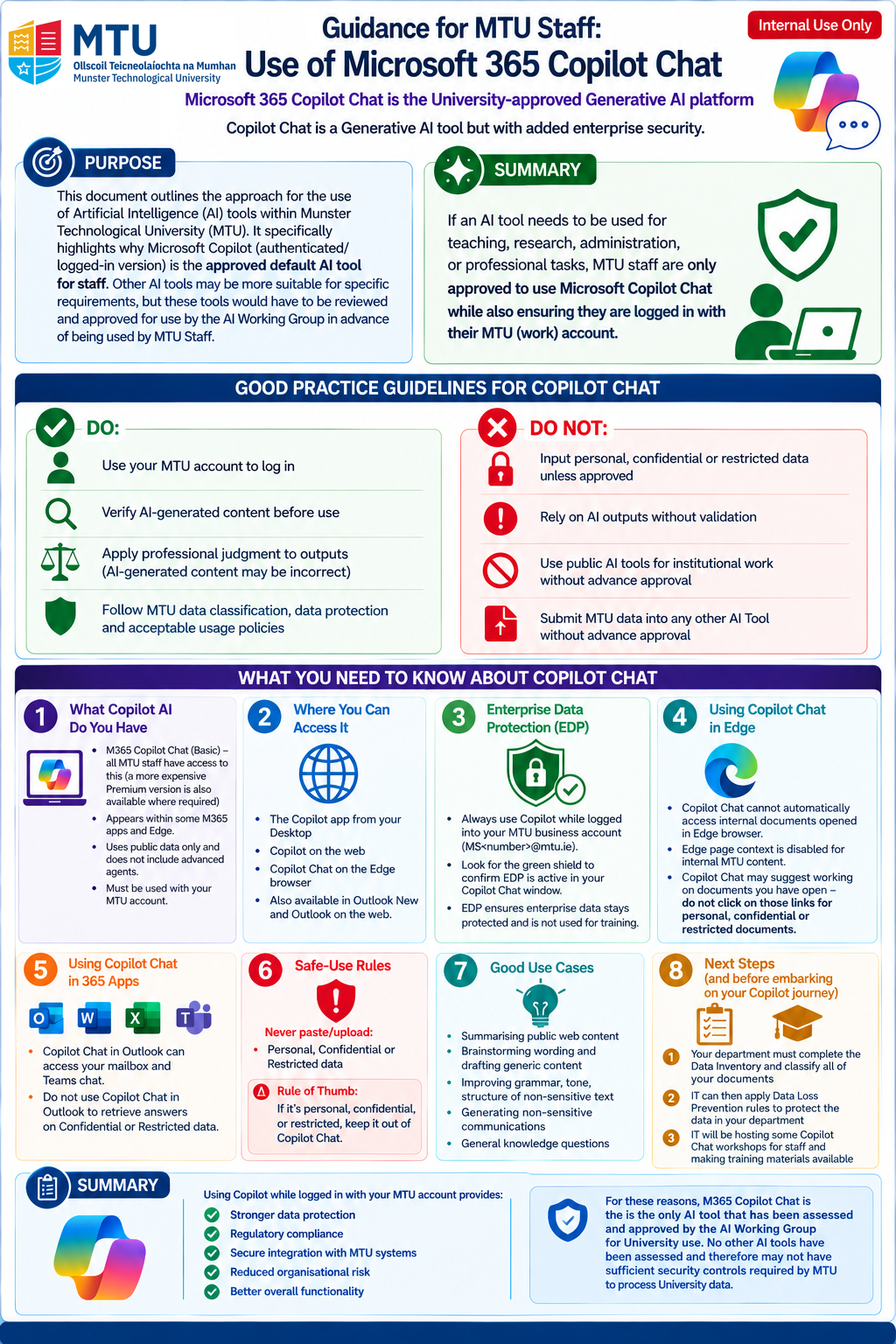
- Microsoft Copilot Chat is currently MTU's approved general-purpose AI platform for University use.
Related MTU Policies
2.2 HEA Policy Framework (December 2025)
The HEA's Generative AI in Higher Education Teaching and Learning: Policy Framework serves as the national reference point for Irish higher education institutions.
The Five Principles
| Principle | What it means in practice for teaching staff |
|---|---|
| Academic Integrity, Transparency and Accountability | Make permitted AI use explicit. Students remain responsible for submitted work. AI detectors should not be treated as conclusive evidence. |
| Equity and Inclusion | Avoid creating advantage for students who can access premium AI services. |
| Critical Engagement, Human Oversight and AI Literacy | Human judgement remains central. Teach students to evaluate AI outputs critically. |
| Privacy and Data Governance | Use approved systems and treat student information as highly sensitive. |
| Sustainable Pedagogy | Use AI only where it adds educational value and consider environmental impacts. |
Supporting Publications
| Document | Use it for |
|---|---|
| Principles for Ethical AI Adoption | The ethical foundation of the framework. |
| Evidence for the National Policy Framework | Research underpinning recommendations. |
| AI-Resilient Assessment Practices | Assessment redesign guidance. |
| AI Literacy Training | Staff and student literacy development. |
| Alignment with the EU AI Act | Understanding requirements under EU law. |
| AI Fluency Framework v1.1 | The 4D competency framework. |
| Sectoral Perspectives | Irish HE sector insights and practical guidance. |
| Ten Considerations for GenAI Adoption | Programme team reflection and discussion. |
2.3 EU AI Act: What Applies Now
Key Message for Teaching Staff
Do not use AI to grade, rank, admit or proctor students unless MTU has formally approved that specific use.
| Date | What Applies | What it Means for Teaching |
|---|---|---|
| 2 Feb 2025 | Prohibited practices and AI literacy duty | Emotion recognition tools are banned in education. |
| 2 Aug 2025 | General-purpose AI provider obligations | Requirements apply mainly to vendors. |
| 24 Jul 2026 | Digital AI Omnibus | Institutions must support development of AI literacy. |
| 2 Aug 2026 | Transparency obligations | AI systems must disclose AI-generated interactions. |
| 2 Dec 2026 | Watermarking obligations | AI-generated content marking requirements commence. |
| 2 Dec 2027 | High-risk education systems | Strict requirements apply to educational assessment and admissions systems. |
2.4 QQI, NAIN and Other Irish Guidance
| Source | Document | Why it Matters |
|---|---|---|
| NAIN / QQI | Generative AI Guidelines for Educators | Foundational national guidance. |
| NAIN / QQI | NAIN Strategy 2025–2028 | Sets national academic integrity priorities. |
| QQI | Analysis of Generative AI Survey | Irish evidence on AI use across tertiary education. |
| AI Advisory Council | AI and Education Advice Paper | Government-level recommendations. |
| Government of Ireland | Guidelines for the Responsible Use of AI in the Public Service | Responsible public-sector AI practice. |
2.5 International Guidance
OECD
Digital Education Outlook 2026: Exploring Effective Uses of Generative AI in Education.
UNESCO
Guidance for Generative AI in Education and Research.
UNESCO
AI Competency Frameworks for Teachers and Students.
European Commission & OECD
AI Literacy Framework.
European Commission
Ethical Guidelines on the Use of AI and Data in Teaching and Learning.
TEQSA
Enacting Assessment Reform in a Time of AI.
Russell Group
Principles on the Use of Generative AI Tools in Education.
Jisc / QAA
Sector guidance, AI maturity tools and quality-assurance resources.